
Why didn't my target go up this session?
Usually your reps are still climbing the range, or you came one rep short of moving the target.
A quick example
Your chest press has a rep range of 8 to 12. Your target is 10 reps at 45 lb.
- You get 10, 10 and 9.
- Your lowest set is 9. One more than that is 10.
- 10 is the target you already had, so it holds at 10.
That is a hold, not a failure. Reps inside your range are never treated as one.
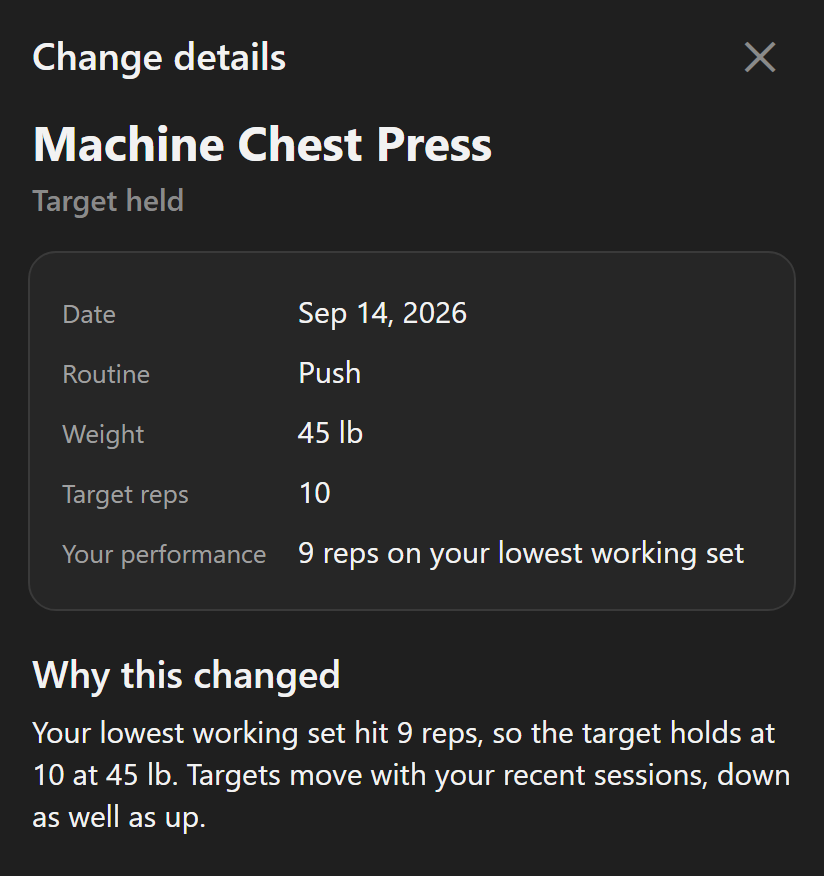
The weight waits for the top of the range
BulkForged uses double progression. You climb the rep range first, and then the weight moves.
- The weight goes up only when your lowest working set reaches the top of the range.
- Then reps reset to the bottom and you climb again.
- Until then the rep target is what advances, to one rep above your lowest set.
When nothing moved at all
- You came a single rep short, as in the example. The target waits for you there.
- One set came in under your target and your other sets reached it. The target holds.
- Two sets came in under it. Then the target eases down to one rep above them, and climbs again when you beat it.
- The exercise had only one working set and it came in under. That set decides on its own, so the target eases the same way.
Sessions that leave targets alone
None of these mean you did anything wrong.
- A deload week or Go light. Light sets never lower your targets. A lift only moves up if you hit its full target weight and reps. Training light when you planned to is the session working.
- No working set counted. The exercise was not logged, the sets were not marked complete, or they were far below your working weight. The exercise counts as skipped and the target waits for next time.
- The session was logged somewhere else. Targets are kept per routine. A Quick Workout, a Record Attempt, or the same lift on a different training day does not move this routine's target.
When to look closer
- A stall is the same weight and reps for two or more sessions in a row. Look at your recovery, or consider a deload.
- One in-range session that did not reach the top is normal progress in motion.
Related: How progressive overload works, Logging a workout, Progressive overload change detail, What is a deload week?.