How progressive overload works
After each workout, BulkForged reads your working sets and sets your next targets, reps first and then weight.
A quick example
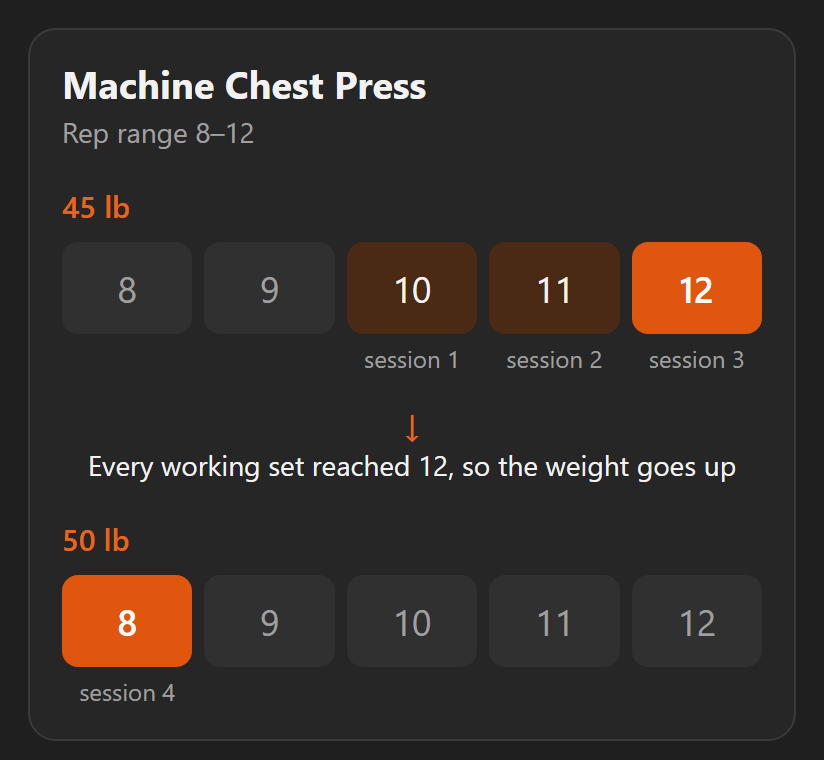
Your chest press has a rep range of 8 to 12. Your target is 10 reps at 45 lb.
- You get 10, 10 and 10. Next session asks for 11.
- You get 11, 11 and 11. Next session asks for 12.
- You get 12, 12 and 12. The weight goes up to 50 lb and reps go back to 8.
Then you climb the range again at the new weight.
Your lowest set is the one that counts
The last set is usually the hardest. Reaching your target when you are most tired is what earns the advance.
- If your lowest working set reaches the top of the range, the weight goes up. Reps reset to the bottom of the range.
- Otherwise the next target is one rep more than your lowest working set.
- A session inside the range still moves you forward. Get 8 in a 6 to 12 range and next session asks for 9.
When a set comes in under your target
One short set is not a sign you got weaker.
- One set under your target, among several, does not pull it down.
- When a second set agrees with it, the target eases to one rep above those sets.
- When the session has only one working set, that set decides on its own.
- Beat the eased target and it climbs again.
When the target stays the same
- One more rep than your lowest set lands on the target you already had. You came one rep short, so it waits for you there.
- The session was a deload week, or you marked the exercise with Go light. Light sets never lower a target. It only moves up if you hit its full weight and reps.
- The exercise had no completed working sets, so it counts as skipped.
- The same lift was logged in a different routine. Targets are tracked per routine.
If your goal is endurance
The app takes a gentler approach to reps.
- It adopts the reps you did instead of asking for one more.
- A hold means your sets already matched the target. One short set among several does not pull it down.
- The weight still goes up when every working set reaches the top of the range.
When you lift heavier than the target
Not every machine has the exact weight your target asks for.
- Lift heavier than your target and still reach your rep target, and that heavier weight becomes your working weight.
- This happens right away. You do not need to reach the top of your range first.
When it runs
- When you finish a workout in the app.
- When a session logged on your watch syncs in.
You never have to work out your next targets yourself.
See it on video: what goes up after a workout.
Related: Why didn't my target go up this session?, Overload history, What is a deload week?, Why doesn't my logged weight match the target?.