Starting to lift this year
Your first weeks in a gym, in plain words: what to expect, what sets and reps mean, and how to get a plan without guessing.
What happens my first three days in a gym?
- Day 1 feels slow. You are learning machines and the room, not testing your strength. Light weight and clean form beat a heavy weight and a rushed one.
- Day 2, two or three days later, is for a different set of muscles, so yesterday's soreness does not have to be gone first. A routine built around a split (legs one day, upper body another) is why.
- Day 3 is where the first real numbers show up. You will lift a little more than day 1, not because you got stronger in days, but because you are no longer guessing the weight.
Nothing about those three days needs you to know your "program" in advance. Pick a plan (see "How do I start?" below) and the first session tells you more than reading ever will.
What do sets and reps mean?
- A rep (repetition) is one full movement — one push-up, one pull on the machine, one squat down and up.
- A set is a group of reps done together, then a rest. "3 sets of 10" means three rounds of ten reps, with a short rest between rounds.
- A working set is one that counts — done with real effort, not a light warm-up rep done to learn the weight.
- A rep range, such as 8 to 12, is the window an exercise is trained in. You are not failing if you only hit 8 — that is still inside the range.
How does the weight go up?
Add reps until every working set reaches the top of your rep range. Then add weight, and start back near the bottom of the range.
A worked example at a rep range of 8 to 12:
- Session 1: 8, 8, 7 reps. Your lowest set is 7 — try for 8 everywhere next time.
- Session 2: 9, 9, 8 reps. Getting closer.
- Session 3: 12, 12, 11 reps. Almost there.
- Session 4: 12, 12, 12. Every set reached the top. The weight goes up, and reps reset near the bottom of the range.
This is called double progression: add reps to the top of the range, then add weight. It judges you by your hardest set, not your easiest one — the last set of three is the one done most tired, so if even that one reaches the top, the weight really is ready to move.
One short set among several is not a setback. The target holds, and you try again next session.
Doing that math for every exercise, every session, by hand is the tedious part most beginners quit over. BulkForged, our app, runs this exact rule after every workout and sets your next target for you.¹
What is a deload for?
A deload is a planned lighter week — about half your normal weight, same reps — taken every 6 to 8 weeks, or sooner if you feel run down or your numbers stall for two sessions in a row.
The one thing to know: a deload never lowers what you were lifting before it. You train light for a week, then go straight back to your full weight. It is a week off the gas, not a step back.
How do I start?
You do not need to design your own program to start lifting. "The default plan is for someone new to the gym" — it opens light, at two sets of each exercise, across full-body days that cover every major muscle group.
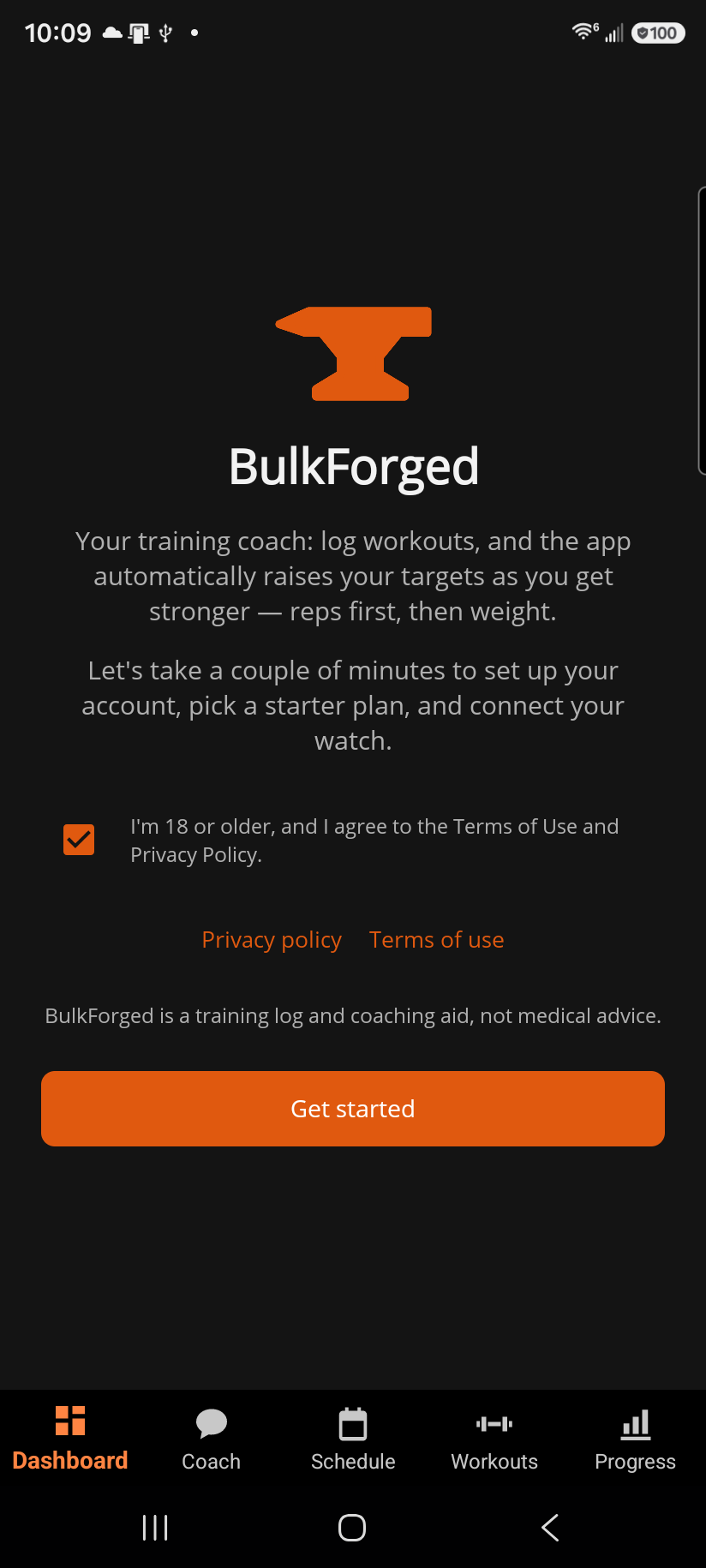
- Open the app and tap Get started. A plan is already built, before any question: three full-body days a week, for a full gym.
- Review it — the routines, the days, and a note that the starting weights are deliberately light. Tap Change if you train a different number of days, or somewhere else (home equipment, or your own list).
- Tap Create my plan. There is no separate confirm step after that.
- Train. Whatever weight you actually lift becomes your new target from there — the starting numbers are a beginning, not a test you can fail.
Trained before, or found the default plan too light? One tap makes it harder.
¹ Part of Coaching, the paid plan. Every install starts with 14 days of it free, with no card.
Related: Onboarding, Getting a plan, What is a deload week?.
Get BulkForged on Google PlayMore guides
- Best strength training and lifting apps for Garmin watches
- Does Hevy work with Garmin?
- Does Strong work with Garmin?
- Does StrongLifts work with Garmin?
- Does Fitbod work with Garmin?
- Does JEFIT work with Garmin?
- Does Caliber work with Garmin?
- Which workout apps set your next weight?
- Gravl vs BulkForged on a Garmin watch
- LiftTrack vs BulkForged on a Garmin watch
- How to log a gym workout on a Garmin watch
- Why your Garmin miscounts reps
- When should you add weight?
- How many sets per muscle per week?
- How to keep muscle while losing weight
- Which Garmin watches run BulkForged?
- Switching to BulkForged from Hevy or Strong
- One gym workout on a Garmin watch, press by press
- Questions to ask before you install
- BulkForged for iPhone: coming soon
- BulkForged and Garmin Connect: what's saved where
- How the watch and phone stay in sync during a workout
- Phone in the locker, workout on your Garmin
- Machine taken? Skip to another exercise
- How to track progressive overload on a Garmin
- Why Garmin Strength Coach skips some weights
- Fix Garmin Strength weights, names and sets
- Which Garmin watch is best for lifting?
- BulkForged on the fēnix
- BulkForged on the epix Pro
- BulkForged on the Forerunner
- BulkForged on the Instinct 3 AMOLED
- BulkForged on the Venu
- BulkForged on the vívoactive
- BulkForged on the Instinct
- Setting up a new Garmin for the gym